Papír nůžky kámen / Paper Scissors Rock
Zbyněk Baladrán, Lygia Clark, Jan Činčera, Milan Grygar, Alva Hajn, Iva Krupicová, Jaromír Novotný, Květa Pacovská, Jakub Polanka, Jiří Thýn, Jan Wojnar
curated by Emma Hanzlíková
24 September – 15 November 2025
 exhibition view, photo: Jan Kolský
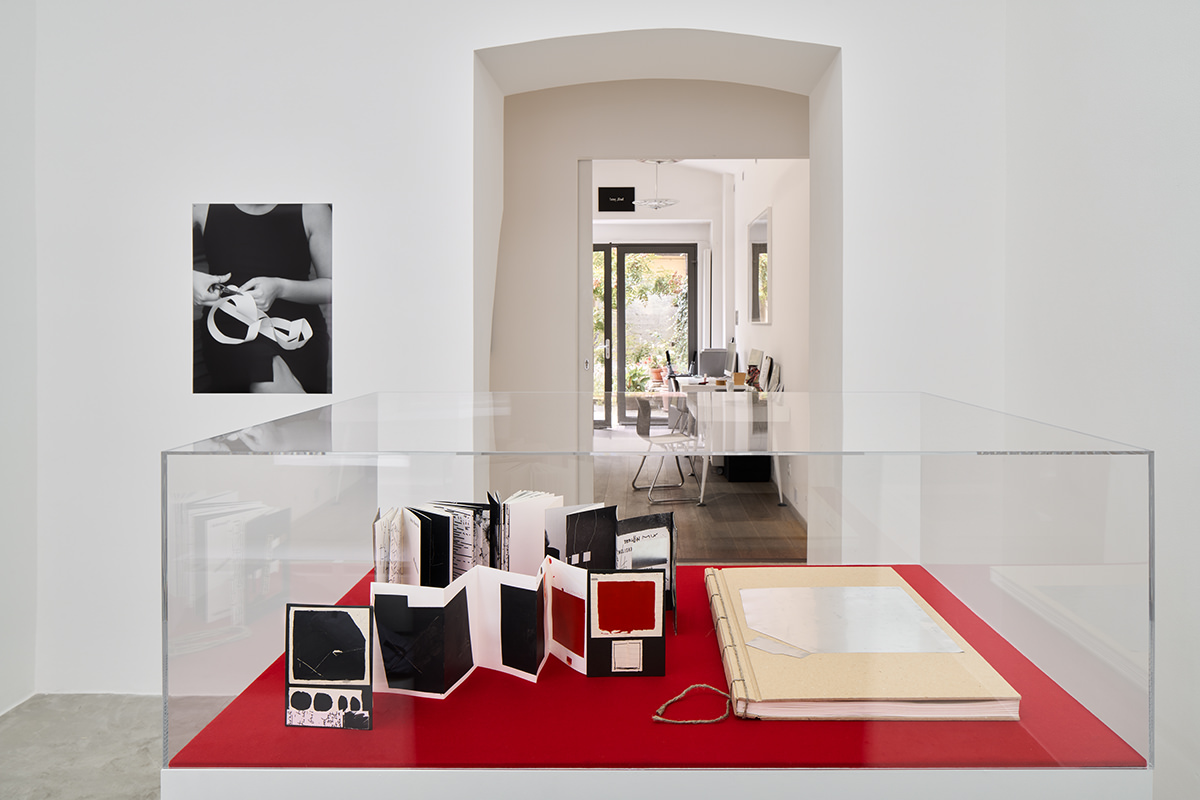 exhibition view, photo: Jan Kolský
 exhibition view, photo: Jan Kolský
 exhibition view, photo: Jan Kolský
 exhibition view, photo: Jan Kolský
 (shelf) Jaromír Novotný, Untitled, 2012/2025, photopaper, paper, wood, glass, dimensions variable, (table) Jan Činčera, Petra (Jordan), 1997 and Untitled, c. 2000, paper, dimensions variable
 Jaromír Novotný, Untitled, 2012/2025, photopaper, paper, wood, glass, dimensions variable
 exhibition view, photo: Jan Kolský
 (left) Jan Wojnar, Autofotogram, 1977, photogram, 3 pieces, 29 x 20 cm each, (right) Jiří Thýn, Untitled, from the series Basic Studies / Non-narrative Photography, 2012, Lambda print, MDF board, 40 x 33 x 3 cm
 Jakub Polanka, Tschumi, 2025, silk paper, pigment, ca. 175 x 145 cm
 Milan Grygar, Tactile Drawing, 1969, filmed by Dobroslav Zborník, 1983, courtesy of the artist
 exhibition view, photo: Jan Kolský
 exhibition view, photo: Jan Kolský
 Iva Krupicová, Erratic Boulder – Mine, 2019, French binding, paper, leather, stone, 59 x 52 x 35 cm
 (wall) Lygia Clark,Obra Moles / Soft Work, 1964, “The World of Lygia Clark“ Cultural Association, exhibition print, (monitor) Zbyněk Baladrán, The long-ago death of a fly, 2010, HDV, 3 min 16 s
“Sometimes I work all day
or sometimes all week
and I’m not satisfied,
so I take scissors
and cut everything up,
and I’m again dissatisfied,
so I paste it all back”
(Květa Pacovská, Scrap, Praha: Aulos, 1997)
The aim of the exhibition “Paper Scissors Rock“, which presents different approaches to the medium of paper, is to enhance our appreciation for this material. Artworks made of paper and on paper are often overlooked by collectors, as if fragile paper were not a fully legitimate medium for artistic expression, and concerns about its instability further discourage its use. Yet, the transience of paper leads us to a different understanding of time. When we worry about the durability of paper artworks, we also reflect on their future, and this anxiety encourages us to focus on experiencing the present moment even more intensely. The artists featured in the exhibition span multiple generations and are united by their choice of paper. They explore its potential in unexpected ways, whether through its materiality or its conceptual significance.
In a cross-cultural context, paper is associated with writing and intellect. In the European tradition, this usually takes the form of books. While turning the pages of a book interrupts the flow of the narrative, Asian scrolls offer a continuous narrative. Even then, there were no concerns about the fragility of paper scrolls—the oldest examples of paper dating back to the 2nd century BC have been preserved in the Dunhuang cave complexes in China. In Asian culture, this material has a much stronger position and is not devalued even in forms other than writing or painting. The paper wrapping itself, carefully folded to protect and decorate, can conceal a gift and also be an integral part of it. The art of paper folding (origata) became an essential skill for both the aristocracy and the common people. Paper is a suitable medium for ink paintings, frottage of stone steles, and for burning sacrificial money delivered to deceased ancestors. Korean and Japanese paper played an important role in the transparency of architectural spaces and became a common part of life.
Now, visually tactile paper is leaving studios and ceasing to be a sketch, mock-up, or proof. It is an intuitive illustration of the creative process and an authorial gesture. When the flatness of paper is disrupted by folds or cuts, when it is layered, when light is imprinted on it, it is burdened with creative ideas or memories that can be as heavy as boulders. Květa Pacovská described the diversity of working with paper: “In the world of paper, we can: glue, fold, assemble, adjust, cut, uncover, soak, wipe, touch, rustle, add, cut through.” She points to the possibility of recording the artist’s free thoughts, unburdened by concerns about the longevity of the work, which often predetermines its form. When we touch paper today, it is most often when reading books, turning pages. For Pacovská, reading with all five senses was her life credo. Her books span several artistic media; they can be objects, sculptures, illustrations, or simply books.
Paper is the primary medium for developing artistic ideas and visions, yet it is only a secondary material when choosing a suitable medium for the work itself. Thanks to its independence from classical forms of visual art, it allows for flexible movement between formal studies and conceptual creation. In the visual arts, paper is most often associated with two-dimensional forms—graphics, drawing, pastel, watercolor, photography, or collage. Although paper is primarily perceived as a flat surface, it is not difficult to work with it as a three-dimensional material, whether in a book, sculpture, or performance. For a long time, paper was considered a transient material, suitable for initial sketches and studies, but not for the final execution of a work. Today, we are witnessing a transformation of this stereotypical perception of paper as a cheap alternative. It is coming to the fore as the primary medium for fundamental artistic creation, without being compared to canvas. Society is reevaluating its approach to paper as a consumable material. Artists themselves have been aware of its qualities for generations. From Picasso’s collages to Schwitters’ Merzbau to the experiments with paper by American abstract expressionists, for whom the exploration of paper matter was on a par with painting itself. In the Czech context, we see a strong wave of work with this material during the 1980s, when the use of paper was often a necessity due to a shortage of art supplies in the underground art scene in the spirit of arte povera.
Although paper may be at the beginning of the creative process, it can become the core of the work, but also its conclusion. It is as if fragile paper symbolically captures the ephemeral nature of human existence. Artists return to paper in the final stages of their creative periods because of its lightness and easy malleability. When Henri Matisse was unable to work at his easel due to cancer, as he was confined to a wheelchair, he began painting with scissors in the 1940s—cutting shapes out of colored paper, which he composed into cut-out paintings. Similarly, Romanian artist Geta Brătescu created her cut-out compositions called Jocul formelor (Game of Forms) at the end of her life.
The title of the exhibition, in which individual subjects influence each other, also refers to an ancient children’s game.
Scissors cut paper, paper wraps stone, stone blunts scissors. Although all three elements are represented in the installation, it is paper that receives the most attention. This easily accessible material emphasizes an almost childlike freedom of creation in the spirit of Josef Albers’ Bauhaus Vorkurs, in which students’ creative abilities were developed through thorough exploration of materials—glass, wood, plastic, metal, and paper. In the 1920s, Albers wrote about the methodology of paper that “Paper is employed mostly lying flat and glued, whereby one side of the paper loses its expression, and the edge is rarely used. This is the reason why we use paper standing, uneven, mobile sculpture, both sides, with an emphasis on the edge. Instead of gluing it, we bind it, stick it into things, sew it, rivet it, i.e. fasten it in other ways, and test its performance under tension and pressure.”[1]
The work of Brazilian artist Lygia Clark is reminiscent of the Bauhaus student exercises. In the 1960s, she experimented with paper cutouts and created geometric shapes that became figures in space rather than images. Her author’s book in leporello format, Livro Obra (1964), in which she recorded her creative processes with paper, explains how she moved from neo-concrete paintings to spatial objects-creatures Obra Moles (Soft Work) and Bichos (Critters). She first created the folded surfaces in paper models and then converted them into modular aluminum sculptures that invited viewer participation. The turning point in Clark’s work, in the shift from art as an object to action and the experience of participatory art without a clear author, was the performative metaphorical work Caminhadno (Walking) (1964). The work is activated when a Möbius strip is cut, creating a paper sculpture formed by an endless closed tangle, with the person cutting choosing their own path for the scissors. The viewer thus not only touches the artwork, but also creates it themselves.
„Make your own Caminhando from a strip of white paper. Cut it across the width, twist it and glue it so as to create a Möbius strip. Then take a pair of scissors, insert the tip into the surface, and cut continuously along its length. Be careful not to cut into the section already slit – that would divide the strip into two pieces. Once you have gone all the way around the Möbius strip, choose whether to cut to the right or to the left of the line already made. This notion of choice is decisive, and in it lies the sole meaning of this experience. The work is your act. As you cut the strip, it becomes thinner and unfolds into intertwinings. In the end, the path is so narrow that it can no longer be opened. It is the end of the shortcut. It allows us to live the experience of a limitless time and a continuous space. It was about creating a new, concrete space–time – not only for myself, but also for others”[2]
Whether we cut the Möbius strip or manage to keep the narrative going indefinitely with paper, this experience brings a binary experience of play and responsibility. Perhaps, in the context of constant digitalization and ubiquitous screen displays, we want to continue to surround ourselves with paper. If we no longer write letters and turn pages less often, then we need the haptic poetics of paper more than ever. Paper works.
Special thanks to Associação Cultural O Mondo de Lygia Clark, Etcetera Auctions, Prague City Gallery, Štěpán Grygar, Vladana Hajnová, and Památník národního písemnictví for their generous loans.
1 Josef Albers, Teaching Form Through Practice (Werklicher formunterricht),1928. English translation by Frederick Amrine, Frederick Horowitz, and Nathan Horowitz Bauhaus, 2 no. 3, 1928, Josef & Anni Albers Foundation, www.albersfoundation.org.
2 Susanne Walther — Frank Vers, Lygia Clark, Franz Erhard Walther. Handlung als Skulptur. Action as Sculpture, Berlin: Distanz 2024, s. 203.